


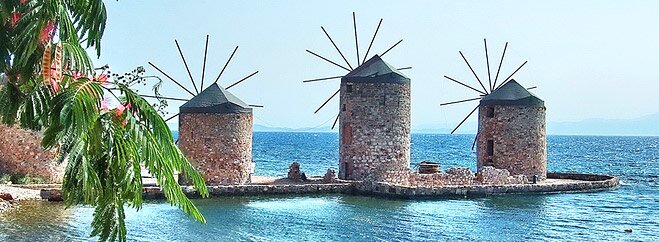

HISTORY OF CHIOS, GREECE
 Chios is known to have been settled at least by the Early Bronze Age but it only enters the main-stream of the Aegean history when the Ionians settle here from about 1100 BC. These Ionians - said to be from mainland Greece - colonized a series of islands and cities along these shores of Asia Minor and soon were taking the lead in advancing Greek culture. It has been generally accepted that Homer was a native of Chios in the 8th century BC. In the following centuries Chios produced other influential individuals including the 5th century tragic poet Ion, the 4th century historian Theopompus, and several important sculptors in the 6th and 5th centuries, one of whom, Glaucus, was credited with inventing the soldering of metals.
Although Chios formed a loose confederation with the other Ionian city-states and islands, they were conquered by the Persians in the second half of the 6th century BC. And then it was the revolt of Chios and these other Ionian states that brought Athens into direct conflict with the Persians and led to Marathon and Salamis. After the Greek-Persian Wars, Chios joined the Athenian League, but soon grew restive under Athenian ambitions. Athens punished the rebellious Chiots in 412 BC, and Chios moved back into alliance with Athens until regaining independence in 354 BC. By then it was too late, for the Macedonian Greeks under Alexander and then the Romans would exert power over virtually all of the Mediterranean, including Chios.
Christianity took hold and Chios came under the Byzantine Greeks, but Saracens abused the island in the 8th century. In the 13th century, in the aftermath of the 4th Crusade, first the Venetians and then the Genoese moved in. Chios actually prospered under the Genoese, but in 1566 the Turks took over. In 1821 Chios joined Samos in the general revolt of Greeks against the Turks, and the next year the Turks singled out Chios for particular punishment, slaughtering an estimated 25.000 Chios and enslaving 80.000; those who escaped went to other islands or on to major cities around the world. Later that year the Greek admiral Kanaris, entered the harbor of Chios at night and blew up the Turkish flagship. Chios gained revenge of sort by entering the immortal realm of art when both Delacroix and Hugo commemorated the terrible massacre of 1822. A major earthquake in 1881 also left many islanders dead, but it has long since recovered, and since 1912 it has been formally joined to the Greek Nation.