


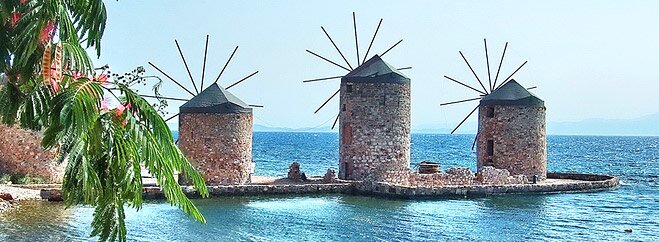

There are more than 30 monasteries and hundreds of churches on Chios. Some of the most important are described below.
.
.
Nea Moni (11th Century Byzantine Monastery)
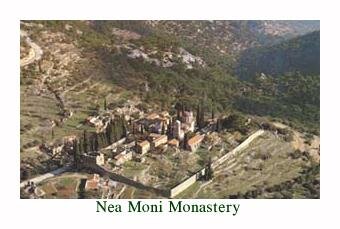 Probably the major historical attraction on Chios is the monastery, Nea Moni, about 11 kilometers from the city of Chios. It was founded in the 11th century when three hermit-monks found a miraculous icon of the Virgin here and they persuaded the Byzantine Emperor Constantine IX Monomachus to build a magnificent monastery and church on this site. This was later expanded by his sister-in-law, the Empress Theodora.
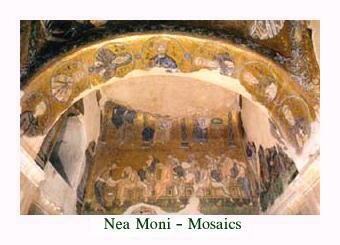 The 11th century church is still considered one of the finest examples of ecclesiastical architecture in this part of the Greek Orthodox world and its mosaics are also highly regarded. Other structures such as the refectory, with its long stone dining table, and a large vaulted cistern are also worth visiting. But the large monastic complex that once housed hundreds of monks is now virtually deserted and recently there have been only a few nuns in residence.
Panaghia Krina (12th - 13th Century Byzantine Church)
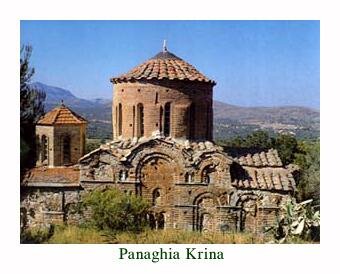 The well-preserved church is modeled on the katholikon of Nea Moni, though on a smaller scale. The relief decoration includes motifs which are known also at Nea Moni. The paintings are products of six different periods, ranging from 13th century to more recent dates. The architectural style of the Churches of Constatinople has been adopted; double blind arcading, raking cornices, pilasters that relieve the surfaces of the walls, curved pediments, arched windows and doors. All the features are enlivened by the natural colors and vivid shades of the materials. More about Panagia Krina
Other ecclesiastical sites
The Monastery of Aghios Minas, 10 kilometers south from the city of Chios. Built in late 16th century. In 1822, during the Massacre of Chios, more than 3000 Chiots were killed in the monastery by the Turks. The monastery is now a national monument.
The Monastery of Panaghia Sikelia, 17 kilometers south from the city of Chios. Built in 13th century. It has distinctive ceramic tile ornamentations.
A few more sites are mentioned on the Medieval Villages.