


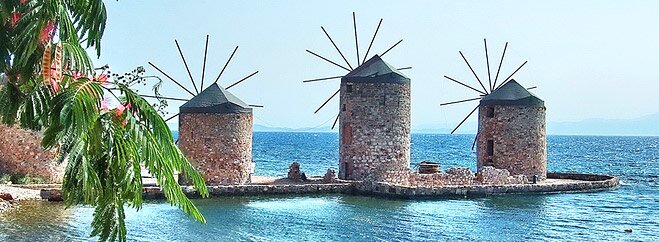

The second most popular excursion on Chios is to the Medieval Villages. The major group of these are also called Mastic Villages (Mastikokhoria), because this is the region where the mastich tree's resin is harvested. The most known of these villages are described below.
Village of Mesta
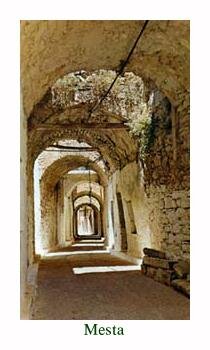 The village of Mesta is the most distant of the medieval villages but it is also the most well-preserved. the form and architecture here is totally unique. The houses are build side-by-side to each-other, so tightly that there are only two entrances to the village. The streets are very narrow, and most of them are covered with arches and vaults. The whole village has been intendently planned and built as a maze, in order to prevent the pirate raiding parties from reaching easily the most important buildings located in the center of the village. The oldest monument of Mesta is the church of Palaios (=Old) Taxiarchis on the north-west part. It was originally a vaulted one-nave basilica, dating from the Byzantine period. In 1794 it was extended to become two-aisled. Some traces of old wallpaintings can be seen, although most of them have been covered with plaster. The iconostasis of the church is wood carved and an excellent example of local woodwork (finished in 1833). To find out more about Mesta, you can visit the Mesta Complete Guide.
Anavatos
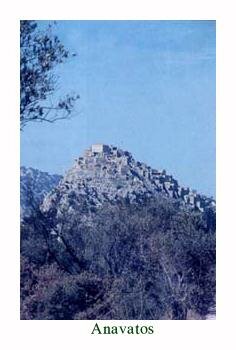 About 17 kilometers West from the city of Chios is the village of Anavatos. It is built on a rocky elevation with sides so steep it can only be approach from one point. The natural defenses of the site make it probable it was originally founded to control the island's west coast during the period of piracy. The village is now completely deserted but the overall shape of the settlement is quite well-preserved to give a unique picture of a ghost town surrounded by a wild and rough natural environment.
Pyrgi
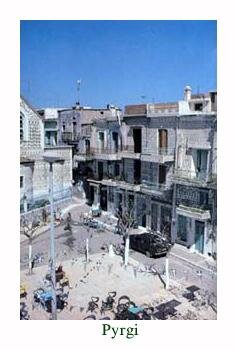 The village is a fortresslike complex of narrow streets, tightly packed houses and arches, with a ruined tower-dungeon at its center. Even more unexpected is the distinctive graffito technique used to decorate the exteriors of many of the buildings: The outer layer of cement is painted white and then geometric shapes (triangles, chevrons, circles, etc.) are scraped away. The church on the main square is truly eye-catching, while off the square is the small church of Aghii Apostoli, with frescoes dated to the 12th century.
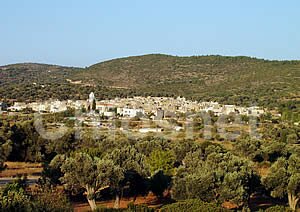 The village of Olympi is located between Pyrgi and Mesta and it has mostly the same architectural form. Closer to the city of Chios are the villages of Armolia (20 km) best known for its <ceramic products>, the villages of Kalamoti, Nenita, Kallimasia and a variety of smaller villages.