


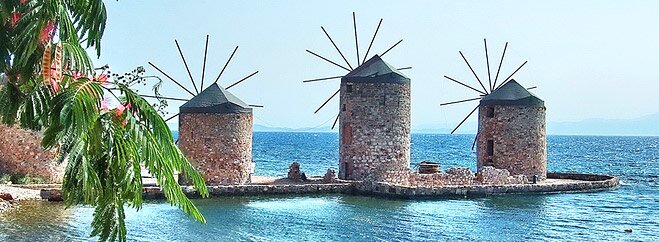

The town of Chios lies in the centre of the eastern coast of the island facing the Erythrean peninsula and Asia Minor. This clearly shows the close relationship it has always had with Ionia. The great geographical importance that the city possessed, at least in earlier periods, derived in part from its proximity to a fertile plain, but mainly from the location of its harbour overlooking the channel to the North Aegean and Constantinople. For this reasons, this has always been the site of the most important city on the island.
 Today Chios (Chora, as it is known locally) is the capital of the prefecture and has approximately 25.000 inhabitants. The headquarters of the Public Services, the Administration and the Cathedral are all located here; it is also the point from which all communications with the outside world originate, both by sea and by air, and the centre of the island's commerce and industry. The city covers a wide, almost flat area, with semi-urban districts extending as far as Kambos in the south and Vrontadhos in the north, which may be regarded as a suburb. To the west the city is limited by hills and to the north by the foothills of Aipos. Towards the east the horizon broadens out and offers a view of the Asia Minor Coast.
The modern city is a bustling port and commercial city, not obviously picturesque and not especially geared for foreign tourists, but a city that offers several diversions to those who like to truly visit a foreign locale. Most of the hotels, restaurants, cafes, gift shops, ticket and travel agencies and such facilities are located around the large harbour quay-road, but the visitor should make a point of walking back from that and explore some of the older streets.
 The center of this old town is the Vounaki Square, which the buses to various points around the island use as their terminal. At the far corner is a small museum with a random collection of archaeological and historical exhibits from the island's past. Some blocks away is the Gymnasion, or high school, built in 1792. The Library of Chios was founded in 1817 by one of Chios's <native> sons, Adamantios Koraes, a famous scholar and educator of his generation (1748-1833) who gave his many books to the library; the library was also greatly enriched in 1962 by the donation of more books by Philip Argenti, a Chiot who had become a scholar in England. On the upper floor of the library is the Ethnological and Folklore Museum with exhibits of local costumes, emproideries, wood carvings, and such works.
.
Modern Chios has owergrown the site of the ancient city, but only a few remains - of walls and the theater - are to be seen. Much more impressive are the remains of the medieval fortress on the northern edge of town; originally a Byzantine fort, it was greatly enlrged by the Genoese in the 14th century. When the Turks took over Chios in the 16th century they also built their own structures over the Genoese houses within the citadel.
.
.
Bibliography for the city of Chios:
Chios, C. Bouras-National Bank of Greece, various guides and books about Chios and Northeast Aegean islands.