
|
|
|
I. Pre-hellenic times
.
Remains of a pre-hellenic pelasgic wall have been found in Limenas of Mesta. The inhabitants of the area (before the arrival of the Greeks) had built their wall on arruged region on the hill over the port. That shows that Limenas of Mesta as well as the wider expanse around it used to have a significant commercial position in Aegean Sea.
.
back to index back to Mesta home page
.
.
II. Ancient times
.
In those times workshops of ceramics and pottery are made in Limenas of Mesta. Even these days potsherds of that era can be traced down in several spots of Limenas.
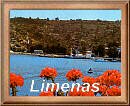 These works created a tradition that lasted until the beginning of the twentieth century. The finds in questions may not be of archaeological interest but they are identical of the dwellers' activity during the Ancient Greek times. It seems that many products of the area reached very distant spots, since (according to tradition) there was a colony in Thraki called Aenos established by the residents of the later Mesta. Indeed Chios as it is related founded one and only colony during the great Greek colonization; that was Maroneia in Thraki and perhaps tradition is the mouthpiece of this event.
There is a witness about the commercial activity of the region that mentions a second port named Nottion (=the south one). The port of Limenas was the North one. According to weather conditions either one or the other was used. All these remarks were made by Stravon the Observer. In accordance with his references and with more recent sources this south port used to be apparently at the gulf of Avlonia or that of Salagona in the south district of Mesta.
.
back to index back to Mesta home page
.
.
III. Roman times
.
During the Roman Age (86 B.C. - A.D. 327) it seems that the activity of the area becomes more intense. A marble sign found on a property in Limenas is related to Athletic Games the so called "Caessaria" that used to take place there. "Caessaria" had started the times of Julius Caesar and took place in many spots of the Roman Empire. Those who organized these games were protected by the emperor. Most specifically the emperor Traianos ordered that whoever would annoy the "Caessaria" organizers would be concerned as insidious enemies of himself. That marble sign is about the organization of the games near the spring (perhaps it is the spring near the small coastal church of Zoodochos Pighi, or another one near the river which ends to Limenas. It also reads about a municipality and officers, a group of youngsters (athletes), polemarchs, priestesses and of chief of ships as well as about imperfections (tax exemptions) as far as the games organizers were concerned. A mere allusion to such offices shows the residents' activity. The reference to a municipality confirms that it was not just a commercial settlement but an organized state which definitely used to include not only Limenas but the entire expanse of Mesta.
.
back to index back to Mesta home page
.
.
IV. Byzantine times
.
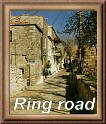
In Byzantine Age (A.D. 327 - A.D. 1346) the region of Mesta follows the historical evolution of the whole island. The different settlements of the wider area now concentrated into a big village for security reasons. From now on if we talk about Mesta we mean one village. Before that the residents used to live in smaller villages - settlements.
The pirate raids that the district of Mesta as well as Chios in general suffered started since the times of Justinianus (6th century A.D.). Between the years 668 and 678 (when Constantinos Pogonatos was emperor) the region undergoes one of the most disastrous raids of the Arabs. In order to be saved the dwellers were obliged to work out defensive understatements. As such they installed at the place known these days as Mesta and they attended to its fortification. Of course it was not the way we see it nowadays, but it was definitely a kind of fort.
 Towards the end of the Byzantine Empire, Mesta together with the other Mastichohoria becomes a matter of rivalry between Orient and Occident. That happened because mastic which was on demand, reached very high prices.
In A.D. 1124 Chios is occupied by the Venetians. They are allotted privileges by the Byzantine empire although in A.D. 1173 they leave Chios because they judged that their presence in the Aegean islands was uneconomical, disadvantageous and impossible. So Mesta together with entire Chios returned to the Byzantines. In A.D. 1204 along with the occupation of Byzantium by the Westerns, Chios comes to the authority of the Latin Emperor of Istanbul. As such Mesta are occupied by the Westerns for a second time within a period of a hundred years. After the regaining of Chios by the Byzantines there is a period of successive western raids the most significant of which - as far as Mesta is concerned - is that of the Catalans in A.D. 1303. By this raid all schini (= the trees that produce mastic) were destroyed. Needless to mention how many years of hard work was needed in order to produce mastic again. It is also easy to conceive the decline of the region which suffered the loss of its primary financial factor.
In order to avoid the danger of being occupied by the Turks, Chios is sub ceded to the Genoans by the Byzantine emperor in A.D. 1304. This lasted for 10 years. The Genoans did not abide by their signature and kept Chios until 1329 when the island was regained by the Byzantine emperor Andronikos.
.
back to index back to Mesta home page
.
.
V. Genoan times
.
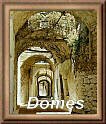
In 1346 Chios is re-occupied by the Genoans up to 1566. The pirate raids that started from Smyrni and Ephessos multiplied. The natives in order to be saved and the Genoans in order to maintain the military and consequently the financial control of the island they co-operated in its fortification. That is how the villages - castles of Chios were constructed. A typical and vivid example of those is Mesta. Apart from the external change the Genoans achieved to control the natives too through the villages - castles. The hardest control was that of mastic; in cases of stealing mastic the penalties were exterminating. In spite of the Genoans' severity the villages - castles dwellers used to live better than those of other regions. The conquerors needed then since they knew everything about mastic cultivation and production. We should underline that the Genoans were the proprietors of schini and more specifically "Maona" was. "Maona" was formed by the Genoans for the political and financial control of Chios. Thus the residents of Mesta as well as those of the rest Masticochoria were simple workers who used to offer their services to "Maona".
 During the Genoan occupation Mesta played a special role because of Limenas which was a natural gift to the village. It is a port in Chios that is not in direct contact with the shore of Asia Minor, where the Turks - the Genoans' main antagonists - used to lurk. As such Limenas was used by the Genoans many times for commercial and military purposes. For instance, when they determined to invigorate the economy of the island a decree was out that obliged all the cargo vessels under the Genoan flag to stop at Chios. The ports where the ships used to stop were that of the capital of Chios and that of Mesta (Limenas).
According to historical sources some military operations started at Mesta. In A.D. 1432 when the Venetians besieged the capital of Chios in terms of their general antagonism with the Genoans, Tomaso Giustiniani who had arrived from Genoa set his troops ashore at Limenas of Mesta. Moreover during the days of the Genoan occupation Limenas was named "Porto di St. Anastasio" (= port of St Anastassios) because the chapel in Limenas which is nowadays dedicated to Zoodochos Pighi was then dedicated to St. Anastassios.
.
back to index back to Mesta home page
.
.
VI. The period of Turkish occupation
.
In 1566 Chios was conquered by the Turks. The new conquerors allotted many privileges to the residents of the island and especially to villages where mastic was produced (Masticochoria). Mesta along with some other villages of the area were dedicated to the sultan's mother. As such during the Turkish occupation it was established that the villages which produced mastic should be dedicated to a member of the sultan's court and that they should form a separate administrative region. It was not depended on the capital of the island, but it was linked directly with Istanbul.
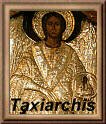 Masticochoria belonged to the region of which Agha Sakiz Eminis was in charge. This region during the Turkish occupation had a powerful local government. The residents of Mesta used to elect the governors of their village (the Elders of the village) and their churchwardens through a general meeting. Their office lasted for a year. The churchwardens were responsible for the village problems; they collected the taxes, they solved certain misunderstandings, or problems in general between the Greeks and the Turks, they appointed teachers and field guards, they also guarded the village wells and the village boundaries.
Furthermore, the Elders of the village took part in the second grade of local government that Masticochoria had established. Along with the Elders of the other villages they were responsible for the good operation of their common hospital (leper-house) in Tholopotami, for their school in Armolia and they participated in the elections for the ephor of Masticochoria in Istanbul.
One of their most important achievements was the providing of the right to sell mastic in the free market. That happened in 1840 when, under the pressure of the Elders, a firman was out by sultan Abdul Metzit. Since that year every village was free to sell the precious product to whoever made him the best offer.
Thus an improvement in the financial state of the villagers is noticed. Even in 1866 when privileges in the entire Turkish empire were abolished by sultan Abdul Aziz, Mesta as well as the rest of Masticochoria retained the right of electing their own Elders and the right of free sale of Mastic.
The greater adventure of Mesta, though, during the Turkish occupation is that of 1822. Lykourgos Logothetis from Samos arrived at Chios and set his troops ashore in order to persuade Chios dwellers to rebel against the conquerors. After the rebels' first successful attempts, the Turks managed to reassemble. The rebels as well as the civilians headed west (toward Masticochoria) so as to be rescued from the Turks' reprisals. Mesta dwellers sheltered many of them from slaughter. In some cases they succeeded, while in some other ones they did not. According to witnesses many of the residents of the capital and Kambos were slaughtered by the Turks outside the castle of Mesta.
The villagers were saved because of one of the elders of the village, Ilias Pipidis, who had been in contact with admiral Andreas Miaoulis from Hydra. He guided the villagers to Merikounta (a coast on the north side of the village). From there most of the villagers went to Psara or Cyclades by Miaoulis ship. Those who did not leave, they hid in some caves or in the fields. Many people were arrested and intended to be sold as slaves in Asia Minor. There is a remarkable case of Nikolaos Tsokos who managed to escape from 100 armed Turks while they shooted him; he ran to Limenas and swam to a French ship that anchored there.
The residents of Mesta were saved from slavery because of their knowledge about the cultivation of mastic. When the Turks realized that they would lose the highest income that they had from Chios, they granted amnesty to the cultivators of mastic. Thus all villagers who had been arrested as hostages were set free and many of those who had left their village returned back. The destruction of the village was great anyway. According to a census conducted in 1802 it consisted of 275 families, 1112 people whereas in accordance with a census conducted in 1831 it had 152 families, that is some 600 people.
.
back to index back to Mesta home page
.
VII. Mesta at liberty
.
In 1912 Chios is free and since then it has become again both geographically and politically a part of Greece. When our country was in hard times the villagers of Mesta as all Greek people defended their homeland. moreover, during peace they worked hard and made progress. Many villagers sacrificed their lives in all wars our country had to participate in (there is a monument for them in the entrance of the village).
During peace many people from Mesta have excelled in literature, arts and trade. Not only have they excelled in Greece but abroad too. Almost all of them, no matter where they live, often visit their village and never forget their roots. It is something they consider as their primary duty.
.
back to index back to Mesta home page
.
.
|
|
|
|
|
