.
.
C. A TOUR IN THE CASTLE
.
.
I. The Ring-Road, the Wall
.
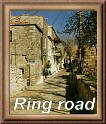 The visitor should leave his own transport at the circus outside the village. The road in the east part of the village makes the Ring-Road of the castle. If one follows it he will reach the point from which he started. The houses on the right side of the surrounding wall are modern. The outer wall on its left side makes the Wall of the castle. The doors and windows of the houses of this side have been opened rather recently. During the Genoan and Turkish occupations the entrances of those houses that formed the wall used to be only at the inner part of the castle. The loopholes were the only openings on the wall and it is them which have been turned into windows later on. The two openings to the inner part of the village have been constructed more recently for the residents' facility. The surrounding wall of this side ends to the tower.
.
back to index back to Mesta home page
.
.
II. The Tower
.
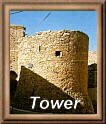 The Tower is one of the four towers the castle used to have on the four corners of its rectangular part. It is circular and consists of two floors which communicate through a spiral staircase. Only three of the towers are redeemed nowadays (unfortunately, the one located at the corner where the parking area is these days has been destroyed). One of the three existing ones is now a residence, a very unique one since it has circular rooms. The towers used to be in direct contact with each other through a tunnel parallel to the outer road.
The loopholes of the tower can be still noticed. From outside they look as narrow openings although from inside they look like tunnels. From the tower by taking the ring road one reaches the entrance of the village-castle.
.
back to index back to Mesta home page
.
.
III. The Gate of the Castle
.
The Gateway of the castle is named by the natives as "door of the captain", that means the door of the governor (it derives from the Italian word "capitano"). The monoliths of which it consists are remarkable as well as the iron door that remains in an excellent condition. The door during the Genoan occupation was opened in the morning at sunrise and closed in at sunset. That did not happen only when there was a danger of a raid but on a daily basis. It is because the village was the place of the natives' dwelling but at the same time it used to exist as a camp for the conquerors. This gate was the only one on the castle so that the conquerors could easily check the entry of the products, especially of mastic. All that was due to defence and the facilitation of the conquerors, since it was according to the products that taxes were imposed.
 The house over and next to the door gate must have been the governor's-captain's residence (that is why it has been named after him). The small window through which the guards used to observe the residents' entry-exit is noticed at the inner part of the gate.
On the way into the castle two of the most ancient churches of the village are located. The first one is that of Aghios Georgios and the second one is that of Aghia Paraskevi, the latter of which is more significant.
.
back to index back to Mesta home page
.
.
IV. The Church of Aghia Paraskevi
.
Aghia Paraskevi is one of the most ancient churches of the village. The sign on its lintel that reads the date 29 March 1709 is more recent and refers to a repairing of the church. It is odd and at the same time miraculous how its frescoes escaped the catastrophe caused by the Turks in 1822, something that did not happen with some other churches of the village. In the centre of the dome Pantokrator dominates. Scenes of Jesus' life and Passion are depicted on the right and left walls. Pictures of saints complement those representations. The predominant feature in the hagiographies in question is the naivety and the innocence of the saints.
It is worth mentioning here that the large number of churches inside and outside the village reveals the peak the region reached during Middle Age. Inside the village there were nineteen churches most of which exist up to these days, in a very good condition. Outside the village there were seventeen more and all of them still persist. The wider expanse of Mesta used to have thirty-seven churches on the whole. Two of them operated as schools since the end of the last century. Christ's church at the square (it does not exist nowadays) was a boys' school and St. Mary's church was a girls' school. The fact that Mesta dwellers had very early been interested in their children's education shows their thirst for learning.
.
back to index back to Mesta home page
.
.
V. The Village Square
.
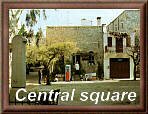 The road on the left of Aghia Paraskevi leads to the village square. The villagers call it "Livadi". The square is a resort after an exhausting day. There is a particular reason that a daily stroll in the square is considered necessary. As it is obvious the house of the village and especially those which form the castle do not provide any open space or gardens since they are built in a way that unites them all. There are cases when the boundaries of two neighbouring houses can be hardly distinguished. As such the square is the only open area of the castle. It is where friends meet, where news are heard, where the villagers have their morning coffee or their afternoon ouzo. Although it is a calm and quiet place on a daily basis, it turns to a centre of bacchic festivities the days the villagers have a feast. Island songs are played by the villagers' musicians and all ages men and women dance until the morning and drink wine and souma of their own production.
.
back to index back to Mesta home page
.
.
VI. The New Church of Taxiarchis
.
The church is dedicated to Taxiarches - Archangels: Michael and Gabrielle. It is usually called "The Big Taxiarchis" by the villagers so that to be distinguished from the other church of Taxiarchis which is more ancient and smaller in size. That one is named "The Old Taxiarchis".
The new church of Taxiarchis is located where the central circular tower of the castle used to be. That tower was deserted after the Genoans' withdrawal and during the Turkish Occupation only night birds, ravens and kinds of serpents lived inside. The villagers considered all those creatures as something evil so the tower was thought to be a symbol of submission. As such they decided to demolish it and to build the church.
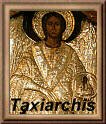 The demolition began in 1858 and lasted for two years. The construction of the church began right after and was completed in 1868. The whole work lasted for 10 years and the workers received 3,500 sovereigns for payment. The transporters who carried the material from the capital received 120 sovereigns. In addition the villagers participated voluntarily in the construction. According to statistics 10,000 quintals of lime (1 quintal = 57 kilos), 163 quintals of iron, 55 quintals of lead and 60 shiploads of a special kind of stone were the necessary materials.
The entire expanse of the church along with the courtyard occupies 985.5 square metres, while the building is 450 square meters in area (such must have been the dimensions of the tower since the church was built in its foundations). The church of Taxiarches is the biggest in Chios and one of the biggest in entire Greece.
As a monumental work that was admired even by those who contributed in its construction, it caused the villagers' inspiration of many stories, some of which derive from reality, while some other ones do not. One of such stories which has been considered as real is the one of the "unfortunate" worker who was crushed by the stones of the tower during its demolition. This incident had worried people a lot because due to a local custom the foundation of a church is not permitted where human blood has been shed. According to testimonies villagers of all ages were digging for days and nights in order to pull the buried worker out. In the end they found him alive, so they continued the construction of the church feeling relieved.
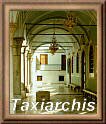 The church outside has a two-way double staircase on the top of which the bell-tower rises. The big bell-tower is very recent. Both the staircase and the bell-tower are made of stone from Thymiana, a village near the capital where a special kind of stone is produced. Later, when the steps showed signs of wear they were replaces by new ones made of local stone. the stairs lead to the churchyard, which is composed by remarkable patterns made of black and white pebbles. Pebbly yards are very typical of the architecture of Chios. On the right side of the courtyard the stairs lead to a place set apart for women. In the narthex a remain of the tower can be noticed: it is the cistern for water , fountana as it is called in Mesta.
Inside, the church is divided into 3 aisles, the central of which is elevated. The pillars that support this aisle are monolithic but have unfortunately been covered by lime mortar and paint due to more recent repairings. The central aisle is dedicated to Taxiarches, while the North one is dedicated to St. Charalambos and the South one to the Apostles. The icon screen of the church was extempore and wooden in the beginning. The present one is made of brick and it has been constructed in 1895. The two icons of Taxiarches which adorn the icon screen are part of the icon screen of "Old Taxiarchis". Many votive offerings are remarkable and complement the prompt of the church. They have been offered by faithful villagers who come from all corners of earth.
Apart from the present ones which have been donated by some villagers who dwell in Athens, Thessaloniki, USA and Australia, sacerdotal vestments, icons and Holly Books of great historical importance have been either brought by the villagers from Russia in the beginning of the century, or sent from Egypt by members of the Mesta community there.
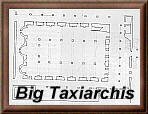 The altar is made of cement and its upper part of a massive monolith. In accordance with some written sources, it took a whole night and work of many people to bring the stone from Limenas to the village. Since some people may wonder how a village with so few residents could build and maintain such a big church in an excellent state, it is worth mentioning some income of the church: Some amount of money is offered by the villagers and foreigners in the form of votive offerings (they have been healed from an illness by the archangels). Besides there is a traditional "tribute" the villagers offer the church, the so called "Katathesimo". In the beginning it was the offering of a fertile field made by a childless resident. This process was followed by either himself through his will or by his relatives after his death. Gradually katathesimo started to be offered also by other people who were willing to donate something to the church. Especially those who did not possess land property or did not wish to give a field, replaced the katathesimo by volunteering to help in any way. Nowadays it is really scarce to find a villager who has not offered Taxiarchis either a piece of land, an amount of money, or some voluntary work.
Returning to the square, the visitor is positive that he has noticed all elements of the late popular architecture of Chios in New Taxiarchis, which is one of the most representative examples of this architecture.
.
back to index back to Mesta home page
.
VII. The Old Taxiarchis
.
Before the construction of "Big Taxiarchis" the villagers used to have as their main church that of Old Taxiarchis. One can go to this church by following the road which starts from the square. The dome with the icon and the suspended oil-lamp at the side road he will meet, the "proskynima" as it is named, leads to the old church of Taxiarches.
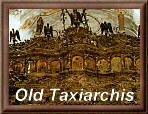 According to the census of churches of Chios, this church has been built in 1412. In the beginning, it was small with arches and one aisle. But as it had to cover the needs of worship of the whole village, a second aisle was added with a united roof. The Northern aisle used to have groin-vaults. This expansion took place in 1794.
The first church had the small door as entrance. It is on the right side of the present entrance, next to the church of Aghios Vassilios. Outside, the more ancient building can be noticed because of the blind apses and the stonework. Inside the old part of the church was adorned by remarkable frescoes which went irrepairable ravages by the Turks in 1822 during the "great massacre of Chios". Since the entire church had serious damages it was repaired in 1833.
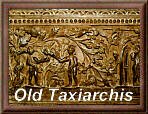 The icon-screen of the church is really remarkable. It is made of walnut tree trunk and it is totally handmade. This scarce and excellent example of local woodcarving has depictions from the Old and the New Testament. Its date of construction is April 14th, 1833. In the highest point under Christ on the Cross, on the basis of the cross all the tools needed for the crucifixion can be noticed: the ladder, the pair of pincers and the hammer. On the next zone below depictions from the New Testament are seen. From left to right: Christ and his twelve disciples, the crucifixion, the deposition from the cross, and the resurrection.
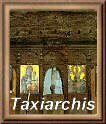 Over the central Sublime Port there is an impressively constructed and audaciously conceived depiction: the sun. It is indeed an audacious inspiration of the artist since Christian worship is very cautious in terms of references to pagan symbols. The most possible explanation is that it has a symbolic meaning and identifies the light of Christian faith. It reminds us of Christ's saying: "I am the light of the world". The lower part of the icon-screen is adorned by scenes from the Old Testament. From left to right: The original sin where Adam's and Eve's figures as well as the snake and the apple can be noticed. The fall from Paradise where Adam and Eve crying pass through the gate of Paradise. The sacrifice of Abraham where Abraham , Isaac and the sheep which takes the child's place can be noticed.
On the wall across the icon-screen the two-headed eagle is painted. That reveals a Patriarchic privilege of the church. The buildings around the church up to the proskynima are connected with it. It seems that this cluster of buildings was a monastery which used to have its own separate defensive armouring.
.
back to index back to Mesta home page
.
.
VIII. The Tower of Militas
.
The main road from the proskynima leads to the Northwest side of the castle, the so called "tower of Militas". It derives from the Italian word militare which means army. The tower can be seen more clearly from the square outside the castle and nowadays it has become a residence. The reason it was named after this word is because it was reinforced by a military force since it is located facing the sea from where all raids were expected.
In order to conceive the significance of the tower in terms of the defence of the castle, as well as the effective of the entire system of defence of the village it is worth to mention the following:
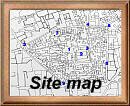
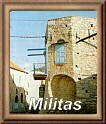 The castle was a quadrilateral with a triangular peak on the Northwest side that ended to the "Tower of Militas". This was the front line of defence. Inside, as it shows in the village plan, two roads which started from the square and converged just before the tower of Militas formed a castle inside the main castle. That was the second line of defence. The main tower where the church of Big Taxiarchis is located made the third line of defence. The central tower received all visual messages sent from Merovigli (=the watch tower of the daytime), the highest mountain of the area, and motivated the whole system of defence. As such if the enemies took the castle they would have to fight hard again so as to seize a second castle almost identical to the former. If they took that too, they should have much more troops in order to conquer the heart of the castle, the central tower.
Anyway, the tower of Militas played the most significant role in the repulse of the raiders because of its position; it also protected the most important good for the besieged, the water. The well is located under the tower in a shed in the inner part of the castle. The ruts on the mouth of the well are very typical; they have been made by the ropes which have been going up and down for centuries so as to draw water out. Since the slabs showed signs of wear some new were placed over the old ones but they were also worn. An underground tunnel used to link the well with the central tower of the castle, so if the enemies conquered the village but not the tower, the besieged people would have water supplies.
The gate which is located in the tower of Militas is more recent. Perhaps there was an emergency gate of the castle at that point. On the way back, the road from the tower of Militas leads to the triangle which is formed by the two inner roads of the castle. At the house which is in the corner of the two roads, remains of another tower can be seen; its existence confirms the idea that a second line of defence existed indeed.
.
back to index back to Mesta home page
.
.
IX. The Exit
.
The other road leads to the square. During the route several side-roads lead to dead-ends. These side-roads, although seem random, they are very cautiously designed. The way they are designed permits the ventilation while they served the needs of defence at the same time. An enemy, who was unaware of the streets and the layout of the village, even if he managed to get into the castle he would get very easily lost in the mazy dead-ends and consequently he would be overpowered by the defenders.
The road continues after the square and by following it, one can see the Big church of Taxiarchis on his left hand and reach one of the most beautiful points of the castle where successive domes motivate one's imagination and bring his thoughts back to the Genoan times, where the armoured soldiers used to walk. It is where the villagers came out in order to chat (a habit that is common up to these days) or the youths in order to steal a kiss from their beloved.
.
.
As the visitor gets out of the castle he has the impression that he has been walking for a long time in a place where history and everyday life have reconciled and they meet future together. Archaeological sights of much more significance than Mesta can be met in many other places in Greece, no one though is so vivid as the place in question.
Mesta is neither the magnificent but deserted town of Mystras in Peloponnese, nor the great but silent Minoan palace in Crete. Mesta is live history.
.
back to index back to Mesta home page
.
.
.
.
All text included in the topic "Mesta", © 1993, 1997 by A. Pashardis
Page design and construction © 1997 by Iason Koufodontis for 
